Ramadan was less than a week away, which meant only one thing…
It was time for the annual Ramadan bulk food prep!
After a big shopping trip for meat, vegetables, flour and approximately half the contents of the supermarket, I was ready to fill the freezer with some of our favourite Ramadan snacks.
Well…
“Ready” might be overstating it.
It was already midday, I had a baby to look after, I was hungry, and looking at the mountain of ingredients on my table was slightly overwhelming.
So naturally, I did what any sensible person preparing to spend hours cooking would do.
I had an ice cream first.
Sometimes you need to mentally prepare yourself for the task ahead.
My plan for Ramadan Meal Prep 2019 was to make:
- Homemade lamb samosas
- Chapli-style lamb kebabs
- Lamb samosa-filled spring rolls
- Chicken mince & vegetable spring rolls
- Chicken kebabs
I knew there was absolutely no chance of getting everything done in one afternoon.
I ain’t no superwoman, you know.
So I decided to take it one thing at a time.
Day One: Making the Lamb Samosa Filling
I started with the samosas because they were going to be one of the biggest jobs.
Lamb Samosa Filling Ingredients
For my large batch, I used:
- Approx. 1.5kg lamb mince
- 1.5kg potatoes
- 4 medium onions
- 7 garlic cloves
- 2 chillies
- 3 tbsp ginger
- ½ cup sunflower oil
- 2 tins chickpeas
- 4 tomatoes
- Juice of 1 lemon
- ½ cup tamarind sauce
- 1 tbsp salt
- 1 tbsp red chilli flakes
- 1 tbsp ground cumin
- 1 tbsp coriander powder
- 3 cups frozen mixed vegetables
First, I peeled approximately 1.5kg of potatoes, rinsed them and chopped them into small-ish cubes.
Were they perfectly cubed?
No.
Were they meant to be cubes?
Yes.
That’s good enough.
I covered the potatoes with cold water, added a little salt and boiled them until just soft before draining them and setting them aside.
Next, I used my trusty food processor to chop the onions, chillies, garlic and ginger.
That little chopper has been through a lot with me over the years.
Love you, chopper.
I heated the sunflower oil in a large pan and cooked the onion mixture until softened and lightly browned. I then added the lamb mince.
Once that was cooking, I added the vegetables, seasonings and two tins of chickpeas, followed by the processed tomatoes, lemon juice, cooked potatoes and tamarind sauce.
I love the tanginess of tamarind in samosas and, looking back, I probably could have added even more.
Once everything was cooked and combined, the filling was ready.
And that was…
Pretty much all I managed on Day One.
The baby had other ideas about my productive bulk-prep afternoon.
Such is life.
Day Two: Homemade Samosas
The following day I was determined to get everything finished because I hate having unfinished jobs hanging over my head.
First up: homemade samosa pastry.
Homemade Samosa Dough Ingredients
I used:
- 10 cups plain flour
- 1 cup oil — I used a mixture of olive and sunflower oil
- 1½ tbsp salt
- 1 tbsp coarse black pepper
- Approx. 4 cups water
I initially added three cups of water, but eventually needed around four cups plus a little extra to get the consistency I wanted.
The aim is a smooth dough that’s neither too firm nor too loose.
Then came the serious business of actually making all those samosas.
How I Make My Homemade Samosa Cases
This is the method I grew up watching my mum use, and it’s still how I make samosas.
I roll the dough out as thinly as possible because nobody wants an unnecessarily thick samosa case.
Unless you do.
In which case, you do you.
I partially cook each piece of dough on both sides before turning it into the samosa cases.
I worked in batches of around 20 samosas because I find the pastry easier to fill and seal while it’s still slightly warm.
Growing up, my mum, sisters and I would make samosas together and divide the jobs between us. One person might cook the pastry while somebody else filled and sealed them, and we’d get through them in no time.
When filling the samosas, make sure your filling has cooled and don’t overfill them.
I used a simple flour-and-water paste to help seal them and then pressed around the edges with a fork.
That both seals the samosa and gives the edge a pretty finish.
Eventually…
66 homemade samosas!
Alhamdulillah.
But I still had filling left.
Quite a lot, actually.
I estimated I probably could have made another 15 samosas.
There was absolutely no chance I was starting another batch of homemade pastry, though.
So…
Turning Leftover Samosa Filling Into Spring Rolls
This is one of my favourite things about bulk cooking: finding a way to use everything.
I already had spring roll pastry sheets, so rather than making more samosas, I simply used my remaining lamb samosa filling to make spring rolls.
I used beaten egg to seal the pastry and managed to make:
30 lamb samosa-filled spring rolls.
And the filling was finished.
Sometimes when you’re cooking, the quantities just seem to work out perfectly.
You know that feeling?
Food just feels blessed.
Making the Chapli-Style Lamb Kebabs
Next came the kebabs.
Thankfully, kebabs are much less labour-intensive than homemade samosas.
Essentially…
Put everything in a bowl and mix it.
My kind of recipe.
Chapli Kebab Ingredients
I used:
- Approx. 1.5kg lamb mince
- 3 medium onions
- 3 tomatoes
- 3 eggs
- 1½ cups gram flour
- 7 garlic cloves
- 2 tbsp ginger
- Juice of 2 lemons
- ½ cup chopped coriander
- 1½ tbsp salt
- 1 tbsp red chilli flakes
- 1 tsp turmeric
- 1 tbsp ground cumin
- 1 chilli
I processed the onions, garlic, ginger and chilli in my chopper, followed by the tomatoes.
Then everything went into a large bowl with the lamb mince, eggs, spices, gram flour, lemon juice and fresh coriander.
And then you mix.
And mix.
Until everything is beautifully, wonderfully combined.
I love plenty of lemon in mine. If it were entirely up to me, I’d probably put ten lemons in there.
I like tanginess, what can I say?
My Easy Bulk Kebab-Shaping Trick
When I’m making a large number of kebabs, I don’t individually shape every single one by hand.
Instead, I put the mixture onto a sheet of greaseproof paper, flatten it and use a round cookie cutter to cut out individual kebabs.
You don’t need a cookie cutter.
A glass or mug works perfectly well too.
Once they’re shaped, I separate the kebabs with greaseproof paper so they can be stacked and frozen without sticking together.
This batch made approximately:
45 lamb kebabs.
At which point I decided I’d earned a treat.
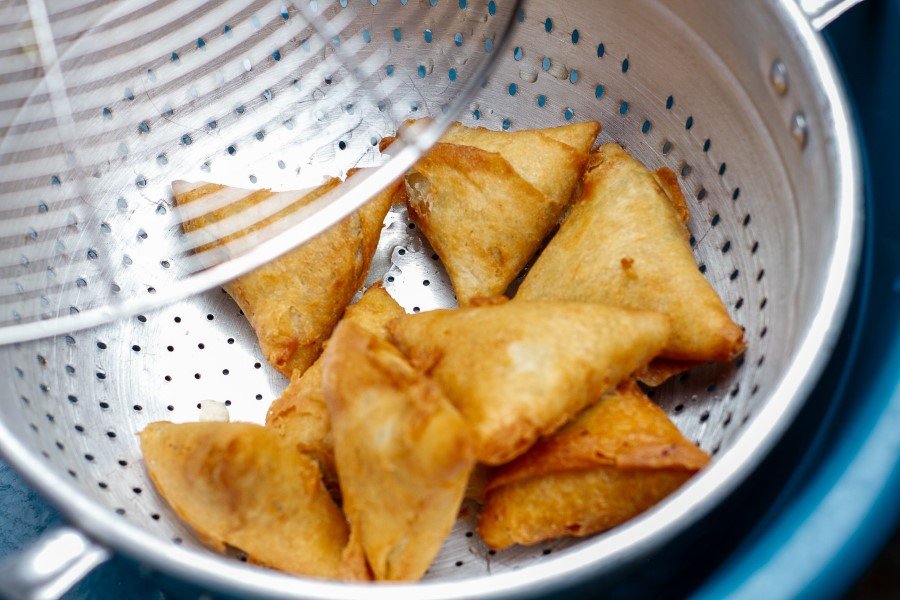
I fried a few kebabs and samosas so we could try them.
Purely for quality-control purposes, obviously.
And Alhamdulillah, they tasted very nice.
Chicken & Vegetable Spring Rolls
It was evening by the time I got to my second batch of spring rolls.
And I was tired.
Very tired.
I’d reached that stage of bulk cooking where you’re no longer lovingly preparing each ingredient.
You’re basically thinking:
Throw it in. Let’s get this DONE.
Chicken Mince & Vegetable Spring Roll Filling
I used:
- 1kg chicken mince
- 2 cups frozen mixed vegetables
- 4 spring onions
- 1 tbsp sunflower oil
- 3 tomatoes
- ½ tbsp salt
- 1 tsp garlic powder
- 1 tsp red chilli flakes
- 1 tsp garam masala
- 3 tbsp lemon juice
- 1 chilli
I cooked the chicken mince with a small amount of oil until it had changed colour and the excess liquid had cooked away.
Then I added the chopped spring onions, chilli, mixed vegetables, tomatoes, seasonings and lemon juice.
I cooked everything together until the vegetables had softened and the filling was ready.
This mixture gave me another:
30 spring rolls.
There was even a little chicken filling left over, so I added some mayonnaise and used it for the children’s school sandwiches.
Nothing wasted!
Finally… Chicken Kebabs
Apparently I hadn’t suffered enough.
There was still some chicken mince left.
So obviously I decided to make another batch of kebabs.
Chicken Kebab Ingredients
I used:
- 500g chicken mince
- 1 red onion
- 3 garlic cloves
- 1 tbsp ginger
- 1 chilli
- 1 tomato
- 1 tbsp lemon juice
- 1 egg
- ½ cup gram flour
- ¼ cup chopped coriander
- 1 tsp mint sauce
- 1 tsp salt
Again, these were really easy.
I processed the onion, garlic, ginger, chilli and tomato before combining everything with the chicken mince, egg, flour, coriander, lemon juice, mint sauce and salt.
Instead of making round kebabs, I shaped these into little sausage-style kebabs.
Why?
I don’t really know.
But I thought they’d be lovely served with chips, tucked into pitta bread or served as part of another meal during Ramadan.
I separated them with greaseproof paper again and added them to the freezer stash.
The Final Ramadan Meal Prep 2019 Freezer Stash
By the time I finished, I was absolutely exhausted.
But look what we’d managed to prepare:
60 samosas remaining after our taste test, 60 spring rolls with two different fillings, around 45 lamb kebabs before sampling, plus a batch of chicken kebabs.
That’s a LOT of Ramadan snacks.
And suddenly all those hours in the kitchen felt worth it.
Why I Still Think Ramadan Bulk Prep Is Worth the Effort
Bulk preparing homemade Ramadan food isn’t effortless.
Far from it.
There’s chopping, peeling, rolling, cooking, filling, folding, sealing, shaping…
And if you have a baby or young children around, what you imagine will be a productive afternoon can very easily turn into a two- or three-day project.
But once Ramadan begins?
I’m always grateful I did it.
Instead of making samosas or kebabs from scratch while I’m fasting, I can take a small amount from the freezer when we want them.
It also means I know exactly what’s gone into our food because I’ve made it myself.
My biggest lesson from this particular prep is probably:
You don’t have to do everything in one day.
Break the job down.
Make your filling one day.
Make samosas another day.
Make kebabs another.
Do whatever fits around your family and your energy levels.
The freezer doesn’t care whether everything was made on Tuesday.
Ramadan Meal Prep 2019: DONE! 🌙
So there we have it.
Another Ramadan freezer prep completed, Alhamdulillah.
Was it an effort?
YES.
Was I tired?
VERY.
Was I ridiculously pleased when I looked at my freezer afterwards?
Also yes.
And that’s Ramadan Meal Prep 2019 complete!
May Allah allow us to reach Ramadan, make our preparations beneficial, give us more time for worship during the blessed month and accept our fasting, salah and duas.
Ameen. 🌙❤️